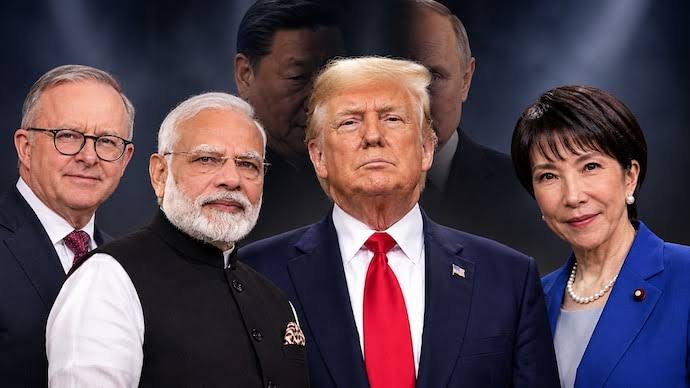
Sparing just 55 minutes is hardly comforting for a US-led alliance that was previously seen as a counterweight to China's increasing dominance in the Indo-Pacific. For the first time in two years, the leaders of the United States, Japan, Australia, and India are scheduled to meet in Manila. The brief meeting of Quad leaders raises an important question: Does Washington still value the Indo-Pacific group, or has it become another casualty of Trump's deal-oriented foreign policy? This comes as US President Donald Trump is getting ready for high-stakes meetings with Chinese President Xi Jinping and Russian President Vladimir Putin.
The question is pertinent because of the time and hours of the meeting that the US president has planned. Before their trilateral meeting with Putin, Trump and Xi are allegedly scheduled to spend 105 minutes together, while the four Quad leaders would have less than an hour to talk on the future of the Indo-Pacific. far of the allocated time in these multinational meetings is spent on diplomatic formalities and interpretation, leaving far less time for meaningful conversations.
According to strategic affairs specialist Brahma Chellaney, as the Trump administration changes its Indo-Pacific strategy and adopts a more conciliatory stance toward China, the Quad is becoming less strategically significant.
In a post on X, former US ambassador to Russia Michael McFaul contended that Washington should prioritize fortifying ties with its democratic allies over concentrating on a one-time meeting with the Chinese and Russian presidents, given Trump's primary focus on relations with Xi and Putin.
A quad summit's significance is not solely determined by its duration. However, in diplomacy, time, political focus, and the readiness to make partnership investments frequently speak just as loudly as formal declarations. In the Trump era, all three of the Quad are starting to raise doubts.
Prime Minister Narendra Modi is scheduled to see US President Donald Trump on Tuesday in addition to the Manila engagements. Since their June encounter at the G7 summit in France, this is their first communication in five months.
THE QUAD: CHANGING FROM A SCHEDULED ENGAGEMENT TO A STRATEGIC PARTNERSHIP
The conference in Quad Manila is important because it represents a group that has had difficulty sustaining political momentum under Trump.
In 2017, as worries about China's military and economic growth grew, the Quad—which consists of the United States, Japan, Australia, and India—was brought back to life during Trump's first term in office. Later, former US President Joe Biden elevated it to the leaders' level and made it a key component of his Indo-Pacific strategy.
Biden held the final in-person summit in September 2024 in Delaware, the United States, and took part in six sessions of Quad leaders, including two virtual ones. The next gathering was scheduled to take place in India in 2025. However, that was not possible due to disputes over trade, tariffs, immigration, and the tension in India-US relations.
Like many other alliances, the direction of the Indo-Pacific group has been further muddled by Trump's return to the White House. In contrast to Biden, who gave the Quad significant political attention, Trump has mainly delegated its high-level involvement to his Secretary of State, Marco Rubio. Cooperation has advanced in sectors like energy supply chains, port infrastructure, and maritime surveillance as a result of the Quad foreign ministers' continued meetings. However, the lack of regular leaders' participation has sparked questions about whether the group's political commitment is still intact.
Since the Quad was never meant to be merely another diplomatic platform, this is especially significant. In order to maintain a free and open Indo-Pacific, it is crucial to unite four democracies with substantial economic, scientific, and military prowess. China's growing influence has played a major role in its creation and resurgence, despite the fact that its members have consistently insisted that it is not aimed at any specific nation.
Beijing has always been suspicious of the organization. As the Quad has extended its collaboration beyond infrastructure, vaccinations, climate change, and disaster response to maritime security, naval coordination, and key technologies, its worries have grown.
This evolution is especially important for India. The Indo-Pacific balance of power is a direct national security concern due to China's military's aggressive maneuvering along the Line of Actual Control (LAC), its rising influence throughout India's strategic neighborhood, and its growing presence in the Indian Ocean Region (IOR).
THE QUAD'S DILEMMA AND TRUMP 2.0'S CHINA CALCULUS
Whether or not Australia, Japan, and India appreciate the Quad is not the main question surrounding it. The question is whether Washington still sees the alliance as strategically significant when its president is also trying to reach a compromise with Beijing.
As Trump's China policy shifts from "confrontation toward accommodation" and Washington's Indo-Pacific policy shifts, strategic affairs specialist Brahma Chellaney contends that the Quad is losing its strategic significance.
Chellaney stated that the group is becoming less and less important to US strategy in a post on X on Tuesday.The strategic affairs expert wrote, "For a grouping once advertized as a cornerstone of the Indo-Pacific strategy, this near-expurgation speaks for itself. The White House's National Security Strategy, in which the Quad receives just one, passing mention, buried in a brief reference to India, makes it clear that the Quad is adrift and increasingly marginal to US strategy."
Kanwal Sibal, a former foreign secretary, has also called attention to the White House's wording regarding the Quad engagement. The fact that the conference is being referred to as a "multilateral meeting with Quad leaders" instead of being clearly presented as a Quad summit is noteworthy.
Although the distinction may seem diplomatic, it begs the question of how much political significance Washington wishes to give the Quad meeting. But Trump's record has been defended by the White House. Olivia Wales, the White House spokesperson, was quoted by the American political digital newspaper Politico as stating that "no administration has done more to advance Quad cooperation than the Trump administration."
Additionally, there is a strategic justification for the meeting's current location in Manilan, the Philippines, a non-Quad member.
In a post on X, former US ambassador to Russia Michael McFaul contended that rather than giving undue attention to a one-time meeting with two dictatorial leaders, Xi and Putin, Washington ought to be celebrating its relationship with democratic friends.A one-time trilateral summit with Xi and Putin is not as important to American national interests as the Quad, McFaul wrote on X.
With trade, investment, and economic concessions, Trump's relationship with China is obviously transactional. However, the economic future of the region is inextricably linked to the US, its Indo-Pacific allies, and China's military and strategic aspirations.
The interest of India extends beyond Washington.
The stakes are higher for New Delhi than just maintaining Washington's interest. In order to counterbalance China's influence without formally joining a military alliance or giving up its strategic independence, India needs the Quad.
India's strategy has always revolved around this distinction. India has upheld its autonomous foreign policy and opposed the Quad becoming an Asian version of NATO, in contrast to Japan and Australia, which are US treaty allies. In addition to Washington's China strategy, New Delhi's involvement is motivated by its own economic and security concerns.
Tensions with other Quad members and Trump's handling of them have also spurred them to increase cooperation outside the Quad. During combined military drills between India and Japan in September, Japanese fighter jets were used in Indian airspace for the first time since World War 2. While Australia, Japan, and Indonesia have started to increase military coordination, Japan and Australia have strengthened their defense cooperation.
Retired Rear Admiral Mark Montgomery, a former director of operations at US Pacific Command, was quoted by US-based Politico as saying that the Quad offers a chance to jointly oppose the Chinese Communist Party, but that chance is being lost.
Montgomery went on to say that Trump's handling of the three allies had hindered India's ability to take a more active role in opposing Chinese aggression outside of the Indian Ocean Region (IOR).
The potential outcomes of the Modi-Trump meeting
Additionally, the Quad leaders' engagement in Manila coincides with a critical juncture in India-US ties. Trump and Prime Minister Narendra Modi are getting together for the first time in five months since their June encounter on the fringes of the G7 summit in Evian, France.
Trade, tariffs, market access, and a temporary bilateral trade agreement are anticipated topics of their bilateral talks. These conversations are important because the Quad's efficacy will unavoidably be impacted by the state of the US-India relationship. If one of the group's most important members is also putting financial pressure on another, the group cannot be considered a legitimate strategic partnership.
Additionally, the Quad's immediate agenda presents chances to exhibit real-world collaboration. According to Reuters, the talks are anticipated to include topics like artificial intelligence, export regulations, critical-mineral supply chains, and maritime security. In light of regional instability and the vulnerability of global energy supply, commercial maritime lanes need to be secured.
Therefore, even if the gathering fails to address the more significant political issues pertaining to the organization, it could provide concrete results.
The bigger question, meanwhile, is whether Trump views the Quad as a long-term strategic investment or merely as a helpful diplomatic statement prior to talks with Beijing. A photo, a joint statement, and a few deliverables might be sufficient within the 55-minute meeting. However, it will take a much longer to restore trust among the member countries with more disparate calculations. And in the Trump era, that is the Quad's true test.


