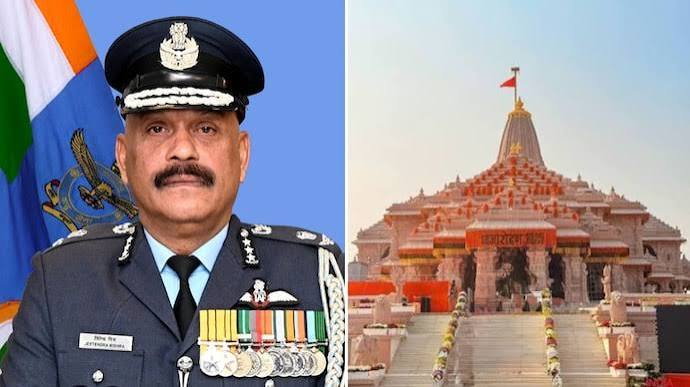
As the organization in charge of the Ayodhya Ram temple reorganizes its management, the Shri Ram Janmabhoomi Teerth Kshetra Trust named retired Air Marshal Jeetendra Mishra as its first chief executive officer. Mishra is a former senior Indian Air Force commander.
At the Trust's meeting on Wednesday, the decision was made. Mahesh Bhagchandka will take over as treasurer under the new arrangement, and Swami Govinddev Giri will no longer serve as general secretary. Additionally, three new trustees have been appointed: Dr. Nirmala Yadav, Madan Mohan Pandey, and Mahesh Bhagchandka.
The nomination occurs at a critical juncture for the Trust, which is also contemplating modifications to its administrative structure in the midst of a dispute over purported irregularities related to donations. The Trust has also talked about ways to count cash offerings with little human intervention.
JEETENDRA MISHRA: WHO IS HE?
On December 6, 1986, Jeetendra Mishra received his commission as a fighter pilot in the Indian Air Force. He has over 3,000 hours of flying experience and served for more than 38 years as a fighter combat leader and experimental test pilot.
He graduated from the Royal College of Defense Studies in the UK, the Air Force Test Pilots School in Bengaluru, the National Defense Academy in Pune, and the Air Command and Staff College in the United States.
Mishra was a chief test pilot at the Aircraft & Systems Testing Establishment and led a fighter squadron during his time in the military. Additionally, he commanded two front-line air bases as an Air Officer.
Later on, he held a number of high-level positions, such as Assistant Chief of Air Staff (Projects) at Air Headquarters, Principal Director of ASR, and Director of the Operational Planning and Assessment Group. Prior to being appointed Deputy Chief of Integrated Defense Staff (Operations), he also held the positions of Commandant of ASTE and Deputy Chief of Integrated Defense Staff for Doctrine, Organization, and Training.
One of the IAF's principal operational commands, Western Air Command, was assumed by Mishra in January 2025. After that, he was in charge of the Indian military's Operation Sindoor, which targeted terrorist organizations in Pakistan and Pakistan-occupied Kashmir.
Mishra has been awarded multiple military decorations, such as the Vishisht Seva Medal and the Ati Vishisht Seva Medal. His receipt of the Sarvottam Yudh Seva Medal and his leadership and direction during Operation Sindoor are also mentioned in the Trust's press release.
According to the Trust's description of the selection procedure, Mishra was from the Deoria district, which is near Ayodhya, and had resigned from the military. His father was a lecturer, and he hails from a middle-class background.
HOW WAS THE FIRST CEO SELECTED?
A three-person Search Committee led by Justice (retd) Pramod Kohli, a former Chief Justice of the Sikkim High Court, was established on July 6, 2026. The other participants were retired nuclear scientist Dr. Suresh Avaran and retired Lieutenant General B K Chaturvedi.
On July 11, the committee convened for the first time to finalize the selection procedure and qualifying requirements. Applications from all around India totaled 5,585.
16 individuals were ultimately shortlisted by the committee and invited to Ayodhya for in-person meetings on August 11 and 12. The candidates' backgrounds, work histories, personalities, and professional skills were evaluated.
In the end, Air Marshal Jeetendra Mishra, Major General Sanjay Pratap Singh Vishwasrao, and Shruti Bhardwaj were suggested for the position. The trustees chose Mishra as the first CEO after weighing the qualifications of all three.
WIDE ADMINISTRATIVE ROLE FOR THE CEO
By amending its deed, the Trust is also working to clearly clarify the CEO's duties and authority. The Trust has a 12-point agenda that includes the suggested modifications.
In addition to managing legal, administrative, and financial issues, the CEO is expected to create operational procedures, methods, and practices that are appropriate for the size and kind of the company.
Strengthening the Trust's organizational structure, guaranteeing adherence to legal and regulatory standards, and supervising the effective administration and future growth of the organization are all part of the job description.
A full-time CEO is essential for professional management and openness in the temple's operations, according to Nripendra Mishra, head of the Ram Mandir Construction Committee. The Trust has insisted that the CEO will report to its general secretary and operate independently of the government.
FINANCES ON TRUST AGENDA, DONATION CASE
The Special Investigation Team investigation into possible donation theft and the ongoing Supreme Court proceedings were also discussed during the Trust meeting. On June 26, Champat Rai and trustee Anil Mishra tendered their resignations, one day after Uttar Pradesh Police filed a complaint over purported irregularities related to shrine donations.
The Supreme Court's judgment broadening the scope of the SIT investigation into purported financial irregularities was applauded by the Trust, which said it will assist establish the truth and dispel public uncertainty.
Proposals from two banks and an IIT were received and will be assessed in order to eliminate human involvement in the counting of cash offerings.
The Trust accepted its 2025–2026 annual accounts, which showed 237 crore in total revenue and 11 crore in expenses. As of March 31, 2026, total funds available were 1,882 crore, while capital expenditure on building and related projects was 425 crore.
As part of the larger reorganization, the Trust has also made choices on open posts and other administrative issues.


