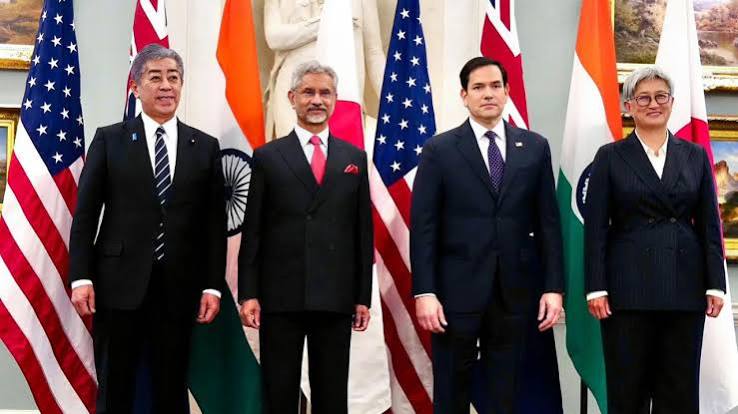
In 2017, four democratic nations with disparate histories and strategic objectives came together due to the growth and forceful posturing of an assertive China. For two years, there were no summit-level meetings of the Quadrilateral Security Dialog, also known as the Quad of the United States, India, Australia, and Japan. However, it returned with a bang on Tuesday, holding a summit in Manila, prepared to face the difficulties of the modern day and make preparations for the future.
In order to ensure the technical future of the Indo-Pacific, US President Donald Trump proposed collaboration among the Quad member countries in artificial intelligence, semiconductors, and essential minerals.
He highlighted intentions to diversify supply chains and lessen reliance on any one nation, characterizing the technology revolution as "bigger than the Industrial Revolution and the internet". According to observers, the Quad's members are united by a common worry about China's expanding technological, military, and economic power as well as its rising meddling in regional affairs. However, the group's members have never presented it as an anti-China front.
Prime Ministers Narendra Modi, Trump, Sanae Takaichi of Japan, and Anthony Albanese of Australia convened for their first leaders' summit in two years. The Quad foreign ministers, who had unveiled significant supply-chain and technology measures at their meeting in Atlanta on October 31, had established much of the foundation before Trump arrived in Manila.
"When leaders show up, they mean business," Sandeep Unnithan, an expert in strategic affairs and defense, told India Today Digital.
Two days prior to Trump's planned trilateral meeting with Russian President Vladimir Putin and Chinese President Xi Jinping in Shenzhen on November 19, the Quad summit took place in Manila.
As Trump pursued better ties with Beijing and Moscow, the second meeting's scheduling cast doubt on Washington's dedication to the Quad. Experts assert that the group's significance extends beyond these diplomatic interactions and gatherings. The Quad's agenda is being shaped by strategic competitiveness and economic security.Maintaining multilateral organizations requires regular political participation. Unnithan added, "The Quad was in danger of falling into this trap when the US became disinterested last year and no heads of government met." "No grouping in today's world makes sense if no prime ministers or presidents don't meet annually."The Quad has been revitalized by the Manila meeting, according to Unnithan.
Significantly, months after India joined the US-led Pax Silica project in February, which aims to secure AI, semiconductor, and vital mineral supply chains and lessen reliance on China, the Quad is making a significant technological push.
Trump claims that the QUAD agenda is larger than the internet.
During his speech in Manila, Trump centered the Quad's agenda around artificial intelligence (AI), which he called Super Intelligence, and cutting-edge technology. He used broad language to depict the extent of the technological revolution.
"Everyone is discussing how this goes beyond the Industrial Revolution. "Bigger than the Internet," Trump declared.
The U.S. President also emphasized the Quad's proposal to offer over $85 million in financial and technical support to increase access to reliable AI technologies throughout the Indo-Pacific region. But the dedication wasn't brand-new. As India Today Digital reported at the time, the Quad foreign ministers made the announcement in Atlanta on October 31.
In order to promote technical cooperation between the four nations and their regional partners, the program includes the Quad AI Accelerator. The Quad AI Accelerator is an effort to support innovative technologies, foster AI innovation, and improve Indo-Pacific collaboration on AI.
It's interesting to note that Australia, India, and Japan refer to it as artificial intelligence (AI), but the October 31 joint declaration used the name Super Intelligence, or SI.
In order to prevent disruptions to companies that rely on semiconductors and artificial intelligence, the Quad countries are also looking for weaknesses and possible bottlenecks in these supply chains.
In order to lessen reliance on China, which controls the supply chains and manufacturing of these important components, the Quad is pushing for vital technologies like artificial intelligence, semiconductors, and rare earths. Everything from cellphones and electric cars to sophisticated weapons and defense gear depends on these technology. For this reason, a security organization is making essential technology the center of its agenda.
India, Japan, Australia, and the US seek to safeguard their supplies, create their own technologies, and stop China from using it as a weapon both strategically and economically by collaborating on cutting-edge technology.
CHINA FACTOR AND CRITICAL MINERALS IN QUAD CALCULATIONS
The Quad's broader objective for economic security includes more than just technology collaboration. Trump also discussed agreements pertaining to rare earths and important minerals, resources needed for semiconductors, electric cars, renewable energy systems, and military hardware.
According to Trump, the agreements were meant to shield each of the Quad nations from being coerced by a single foreign supplier.
Diversification has been a strategic objective for the business due to China's dominance in a number of vital supply chains for mineral processing and refining.
In May 2026, the Quad Critical Minerals Framework was unveiled. During their meeting on October 31, the foreign ministers also applauded a separate US contribution of $10 million for facilities in Asean nations and India that extract essential minerals from garbage.
To promote collaboration between governments and corporations, the four nations have also announced the first Quad Business Leaders' Forum. On Wednesday, November 18, their export credit agencies will convene in Tokyo to discuss prospects for funding and business collaboration.
CHINA'S COMMON FEAR UNITES QUAD
In an interview with India Today TV, Unnithan stated that despite the four nations' disparate histories, China's ascent continues to be the key issue uniting them.
"What unites all these countries is the common dread of China, which, for the longest time, has continued to tell the world about its peaceful rise," said Unnithan. "But as we have seen in the last decade or so, China's rise has not exactly been peaceful, particularly for India, which has held its ground on the Line of Actual Control (LAC) with China."
Unnithan noted that India "has confronted Chinese troops directly" and is one of the Quad nations having a disputed land border with China.It has resisted China's intimidation in both Doklam and Galwan. India has been unwavering, putting its security concerns about China front and center," he stated.
"Of course, we have a very large trade partnership with China as well, worth $150 billion, the highest it has ever been, which would put China in the category of a 'frenemy'," Unnithan stated, drawing attention to a paradox in India's relationship with China: tensions coexist with significant trade.
Unnithan emphasized and gave thanks to Shinzo Abe, the previous prime minister of Japan, for the Quad's inception and its resuscitation in 2017 during Trump's first term. Additionally, he emphasized Washington's crucial role in keeping the coalition together.
Sana Hashmi, an expert on China and the Indo-Pacific region, wrote on X on Tuesday that rumors regarding the Quad's downfall were unfounded. "Quad serves the strategic interests of all four countries, giving each a reason to sustain it," she wrote about X.
Shortly before Trump's November 19 meeting with Xi and Putin in Shenzhen, she emphasized the importance of his Quad involvement. "Timing is everything!" Hashmi remarked.
Thus, the Quad's emphasis on essential technologies demonstrates how the alliance is shifting from maritime security to technological and economic collaboration. The four Quad nations want to lessen their reliance on Beijing while enhancing their own capacities, even as China controls important supply networks and the production of these vital technology. However, even as the group's members pursue their own business interests with China, the true test for Quad will be how swiftly these commitments are turned into tangible initiatives.


