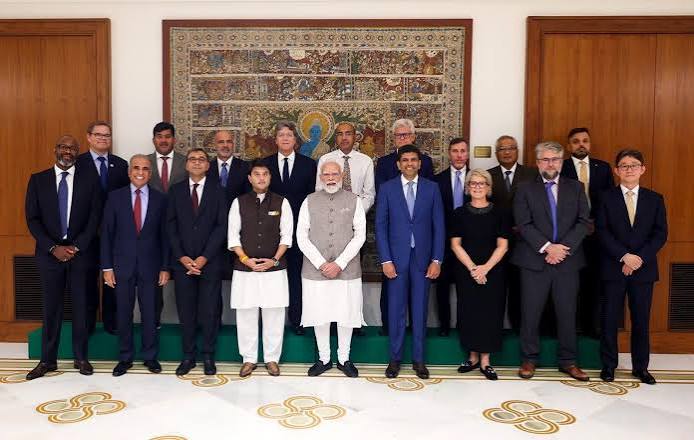
The 10th Indian Mobile Congress was opened on Thursday by Prime Minister Narendra Modi. The PM remarked that India's digital ecosystem had demonstrated how to "Scale Without Boundaries" during his remarks at the event. During his speech, he emphasized the growth of online learning, digital governance, and telecom access in the nation. In reference to the theme of the summit, he stated that the platform had become a showcase for "India's progress and India's dreams" over time.
According to PM Modi, telecom in India now encompasses much more than just networks, spectrum, towers, and speed. "Mobile phones have not only served as a medium of modern communication but have also emerged as an essential tool for good governance over the past 10–12 years," he stated, adding that this was at the heart of the government's ambition for Digital India.
The goal of Digital India addressed the digital divide.
According to Prime Minister Narenda Modi, the digital gap was a significant issue in India up until ten years ago, with modern technology becoming a privilege accessible mostly to the wealthy. PM Modi continued, "We decided to change this landscape by putting the mobile phone right at its center through the Digital India mission."
Modi described it as a significant step toward the democratization of technology and said that rapid infrastructure expansion and telecom sector reforms have been implemented. At the same time, there was a significant increase in local smartphone manufacture. "Every such endeavor made it much easier for the average Indian citizen to access mobile phones and data," the PM said.
According to PM Modi, the COVID-19 epidemic made this ecosystem's strength particularly apparent. However, offices continued to operate in India. Work continued. The pursuit of knowledge never ended. India's digital ecosystem made this feasible.
PM Modi cited the DIKSHA platform to highlight education reforms associated with telecom expansion. According to the Prime Minister, the platform recorded "over 5 billion learning sessions and nearly 60 billion learning minutes" during the pandemic up until July 2022. He stated that connecting about 250 million pupils through digital and online learning platforms was the aim. "To put it another way, every Indian citizen has directly benefited from the telecom revolution," he stated. Covid-19 is also a significant factor in this drive for digital education.
The creative economy and gaming
Gaming and content creation are important components of the digital ecosystem. Prime Minister Narendra Modi emphasized that this had created new opportunities for economic expansion, saying, "Take the gaming sector, for example." Over 500 million Indians are thought to be involved in the gaming industry today, he continued.
"In other words, in India, the mobile phone today is not just a gaming console—it has also become a creation studio," PM Modi clarified. According to Narendra Modi, the country's creator economy has been greatly influenced by mobile phones. He added, "In India, the mobile phone has also democratized content creation."
International framework for cybercrime
Cybercrimes have also grown to be a problem in the online world. PM Modi noted that it becomes a serious issue for the average people. The average citizen does not think about architecture or protocols. "Trust is very important to them," he said.
PM Narendra Modi called for a worldwide framework to address the issue of cybercrime. Cybercrime and cyberfraud transcend national boundaries. They've already gone beyond those limits," he declared. In order to solve this, it is crucial that we strive toward a global framework. Financial organizations, communication providers, governments, and IT firms must all be included in this structure.
Additionally, PM Modi urged telecom companies to collaborate in order to avoid spam fraud and other scams of a similar nature. He said, "I also implore the GSMA and telecom operators worldwide: let's establish a global mechanism that can prevent such fraud from reaching people in the first place." "India is always willing to share its experiences with the world, and it has learned a great deal from its own experience in this direction."


