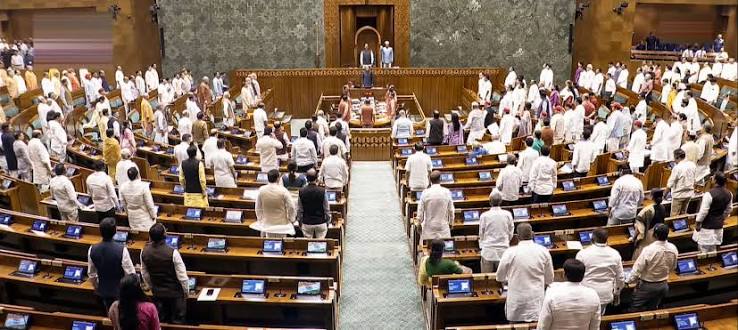
Twelve laws were enacted by both Houses of Parliament on Wednesday, marking the conclusion of the Monsoon Session. However, the government and opposition traded accusations regarding frequent disruptions and the lack of meaningful discussion, especially in the Lok Sabha.
Although the government emphasized the legislative production, concerns about the level of parliamentary scrutiny were raised by the Houses' poor productivity and the majority of measures being passed without discussion. Public examinations, birth and death registration, the number of Supreme Court judges, taxes, banking records, tribunals, mining and minerals, cooperative development, and the renaming of Kerala are among the twelve bills that were approved by both Houses. There was still no progress on the Indian Statistical Institute Bill, 2026.
The 12 bills passed by both Houses are:
-
Public Examinations (Prevention of Unfair Means) Amendment Bill, 2026
-
Prevention of Insults to National Honour (Amendment) Bill, 2026
-
Registration of Births and Deaths (Amendment) Bill, 2026
-
Supreme Court (Number of Judges) Amendment Bill, 2026
-
Appropriation (No. 3) Bill, 2026
-
Bankers’ Books Evidence Bill, 2026
-
Taxation and Other Laws (Amendment) Bill, 2026 Micro,
-
Small and Medium Enterprises Development (Amendment) Bill, 2026
-
Tribunals Reforms Bill, 2026 Kerala (Alteration of Name) Bill, 2026
-
National Co-operative Development Corporation (Amendment) Bill, 2026
-
Mines and Minerals (Development and Regulation) Amendment Bill, 2026
-
The Indian Statistical Institute Bill, 2026, however, remained pending.
In the Lok Sabha, eleven bills were passed without debate. The Lok Sabha had a severe debate shortage throughout the session, despite the legislative production. Eleven of the twelve legislation that were passed were approved by the Lower House without significant debate. Public Exams (Preventing Unfair Methods) The only piece of legislation that both Houses thoroughly examined was the Amendment Bill.
The bill aims to improve safeguards against fraudulent methods in competitive exams, including paper leaks. Slogan-shouting, adjournments, opposition walkouts, and frequent interruptions followed the lack of discussion. According to the administration, the Congress and a few other parties staged a walkout while some opposition parties took part in Rajya Sabha deliberations. 19% LOK SABHA PRODUCTIVITY Only about 19% of the Lok Sabha's allocated time was productive, compared to roughly 39% for the Rajya Sabha.
During the session, the Rajya Sabha convened for 37 hours and 49 minutes. According to parliamentary records, 380 Zero Hour submissions and 380 Special Mentions were accepted, while 285 Starred Questions were posted. Nevertheless, only 16 Starred Questions, 52 Zero Hour submissions, and 93 Special Mentions could be addressed due to interruptions.
RIJIJU TARGETS OPPOSITION
Kiren Rijiju, Union Parliamentary Affairs Minister, attributed the absence of substantive discussion to the opposition, especially the Congress. After the session concluded, Rijiju stated, "A total of 12 bills were passed, but we are not satisfied with the quality of discussion because the opposition did not allow proper debate to take place, especially in the Lok Sabha." Rijiju claimed that although the administration had been open to talking about the issues brought up by the opposition, the latter has consistently shied away from discussion. "The government is obligated to respond to the opposition's requests for answers.
However, he claimed that while the opposition was making reasons to avoid it, the government was requesting discussion inside Parliament.
"HOW CAN NEW MPS LEARN?"
Additionally, Rijiju criticized Congress MPs for what he called persistent sloganeering and interruptions, claiming that the behavior denied recently elected members a chance to become familiar with parliamentary discourse and procedures. If there are no discussions or debates, how can new MPs learn? "The Congress party is to blame," he stated, expressing optimism that things will improve during the Winter Session. The administration is praising its legislative production, while the opposition is challenging the lack of parliamentary debate and scrutiny. With Parliament adjourned sine die, the political dispute over the Monsoon Session is now expected to transcend the House.


