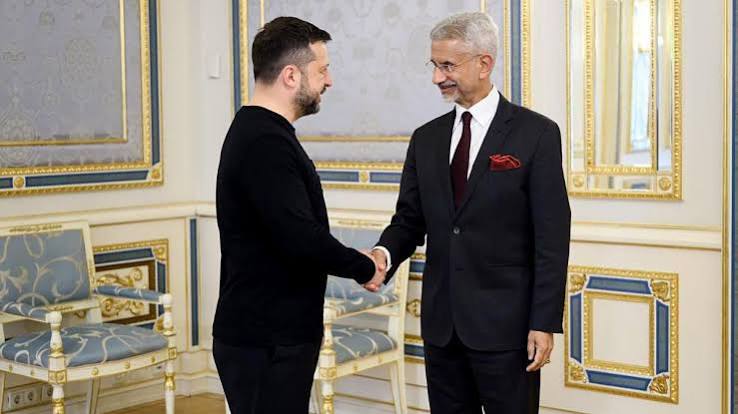
As External Affairs Minister S Jaishankar met with his Ukrainian colleague Andrii Sybiha in Kyiv on Thursday, India declared that it was prepared to provide "any help in any manner" to put an end to the conflict between Russia and Ukraine. Jaishankar stated in a joint press release following the negotiations that India has continuously maintained that diplomacy and communication are the best ways to end the situation.
Jaishankar stated that he would retract the opinions expressed by the Ukrainian side and that his visit was centered on the possibility of negotiations between the two sides. Sybiha said that Ukraine "stands ready for diplomacy" and applauded Prime Minister Narendra Modi's call to stop the conflict.
"India has consistently maintained that this is not an era of war, and that solutions will not emerge from the battlefield," Jaishankar stated. He remembered that Modi had stated that everlasting conflict must now give way to the end of war during a meeting with Russian President Vladimir Putin in Bishkek on the fringes of the Shanghai Cooperation Organization conference two days prior. "Every day that goes by during a fight just results in more casualties and devastation. It makes sense that the parties must figure out a solution. However, we are prepared if India can assist in any way," he stated.
"India is a global power and we welcome Prime Minister Modi's call to move from an endless war toward an end to the war," Sybiha wrote earlier in a post on X." Jaishankar said the trip also took place in the broader context of the war that has been going on since 2022. Jaishankar landed in Kyiv amid growing hostilities between Moscow and Kyiv. "An Indian national was also slain in an incident in Kyiv just two days ago. We offer our sincere condolences to all impacted families and participate in the sadness of every life lost," he stated.
India has also voiced worries over attacks on merchant ships in the Black Sea, according to Jaishankar. He recalled their recent exchanges, saying, "Our conversation today was very free and very open." "There were also some specific aspects of this conflict that came up in our discussions," he continued. Attacks against commercial vessels were the most prominent of them. Indian sailors have been among the tragic casualties of ships flying multiple colors. He said that the impact on shipping was causing shortages of food, fuel, and fertilizer in several Global South nations, and that the two sides discussed these concerns.
He also mentioned the 19 consignments of aid that India has sent to Ukraine as humanitarian aid. Regarding bilateral relations, Jaishankar stated that commerce included consumer items, machinery, chemicals, fertilizers, food and agriculture, and pharmaceuticals. He claimed that although trade had been hampered by the conflict and logistical issues over the previous four years, there had also been resiliency and some new opportunities. "We are fully aware of Ukraine's profound talents and qualities. India is also growing quickly. Additionally, entrepreneurship, innovation, and digital skills are some of these noteworthy sectors of advancement. "The field of artificial intelligence presents new opportunities in health, education, agriculture, and even governance," he stated.
In addition, Jaishankar extended an invitation to Sybiha to travel to India for the next Intergovernmental Commission conference, where both sides examined the effects of the war and talked about bilateral cooperation, diplomacy, shipping, and aid.


