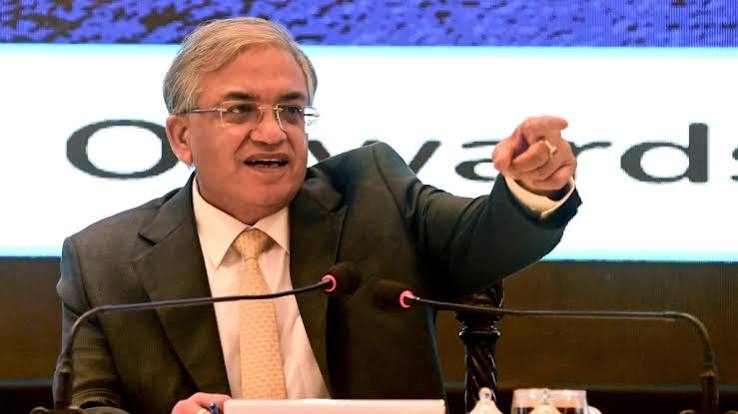
The Election Commission of India (ECI) told the Supreme Court that all three orders pertaining to the Special Intensive Revision (SIR) of electoral rolls were made unanimously by the three-member poll body, refuting claims that Chief Election Commissioner Gyanesh Kumar made decisions unilaterally.
The ECI stated that the accusations were only based on a single news article in an affidavit submitted in response to petitions contesting the CEC's operations and modifications to SIR-related documents. It argued that the affidavit had been unanimously authorized by the CEC and both Election Commissioners.
The poll body also made it clear that recommendations, observations, or questions brought up by the CEC or Election Commissioners during internal deliberations do not constitute Commission conclusions.
According to ECI, all three of Sir's orders were unanimous.
According to the ECI, the Commission unanimously decided to issue the three SIR directives in June 2025, October 2025, and May 2026.
The poll agency explained its decision-making procedure by stating that files are typically reviewed by one Election Commissioner first, followed by the other, before being presented to the CEC. Approvals are obtained electronically in urgent situations and then included into the file.
The affidavit emphasized that, in accordance with Section 18 of the Chief Election Commissioner and Other Election Commissioners Act, 2023, any remarks or questions made by any of the three members during the processing of a file cannot be regarded as a formal decision.
Additionally, the Commission stated that it had neither authorized nor distributed any internal notes or files to the media.
ECI EXPLAINS POSITION ON FORM 6
Regarding the issue regarding modifications to Form 6, which is used for voter registration, the ECI informed the court that the form had not been changed. It stated that the declaration needed for the SIR procedure was a different document and that only the Center had the power to change the recommended form.
The Commission did concede, nevertheless, that the application's online presentation might be seen as an amendment. It stated that starting on October 21, the online application would be divided into a separate declaration and Form 6, in accordance with the format of the paper application.
Voters whose information could not be mapped during the revision would often not be obliged to attend hearings, according to the ECI. Booth-level officers (BLOs) would gather the required paperwork from their residences, and hearings would be held in special circumstances, ideally virtually.
GOA Voter Discrepancies and ECINet Safeguards
Concerning the ECINet system, the Commission stated that an order from the Electoral Registration Officer (ERO) was required before a voter's name could be added to or removed from the electoral roll.
It further stated that a committee made up of specialists from the Indian Institute of Science (IISc) and the Indian Institutes of Technology (IIT) had been established to assess adherence to the recommended precautions.
Regarding the dispute surrounding the 97 Goan voters who were first reported to have been excluded from the electoral records, the ECI stated that 88 of them had already registered, six were overseas, and three possessed Portuguese passports.
Work Allocation Order Explained by ECI
A task allocation order issued on July 28 by an Additional Secretary on delegation to the Commission was also covered by the affidavit. The two Election Commissioners issued a joint directive on July 30, but the ECI said the order was never carried out.
According to the Commission, staff from the state Chief Electoral Officer's office submitted appeals against West Bengal voters' inclusion in accordance with Supreme Court directives. It further stated that the Commission had not been consulted on the issues.
The ECI additionally insisted that any official who issued orders outside of their assigned authority would be disciplined.
TO THE CABINET SECRETARY, TWO ELECTION COMMISSIONERS WROTE
Election Commissioners Sukhbir Singh Sandhu and Vivek Joshi reportedly objected to the adjustments in the July 28 job allocation order and wrote to the Cabinet Secretary on July 29, sparking a dispute.
An exclusively Indian response to an RTI It was verified today that the Cabinet Secretariat received both letters on July 30 and sent them to the CEC's office and the Department of Personnel and Training (DoPT) on August 5. The letters' contents, however, have not been made public.
The ECI had previously made it clear that the issue had nothing to do with policy or the IT department, but rather with the operation of an official on deputation to the Commission. It insisted that the IT division's oversight was never removed and that the modifications were never put into effect.
PLEA TO RESTRAIN CEC IS REJECTED BY ECI
The Commission contended that the request to prevent the CEC from carrying out his duties could not be upheld. It said that only the procedure that applies to a Supreme Court judge could be used to remove the CEC.
It also cited past rulings by the Supreme Court that rejected many challenges against electronic voting machines (EVMs).
The ECI requested permission to provide a thorough, point-by-point response to the petitions, stating that it had issued a quick response due to the Dussehra vacation.


