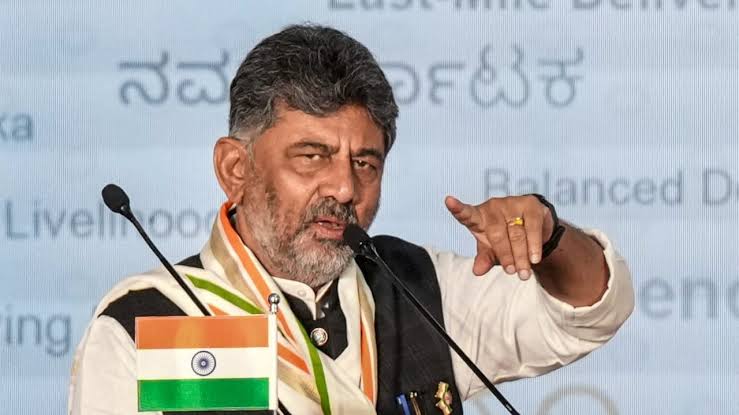
On Thursday, Karnataka Chief Minister DK Shivakumar joined an increasing number of opposition politicians who questioned the Center's plan to impose a 0.4% Merchant Discount Rate (MDR) on person-to-merchant UPI transactions above Rs 2,000.
Shivakumar urged that the Center drop the proposed charge, calling the ruling "pickpocketing of every section of society" and a "insult to every common man."
He contended that even while merchants would be subject to the MDR in theory, companies might eventually pass on the extra cost to consumers by raising prices.
The new framework is expected to take effect on October 15. It stipulates that person-to-merchant UPI payments over Rs 2,000 will be subject to a 0.4% MDR. The fee will be limited to Rs 300 for transactions totaling Rs 75,000 or higher.
Customers will still be able to use UPI to make payments without having to pay a transaction fee. Transfers between individuals and commercial transactions under Rs 2,000 would not be subject to the charge. Additionally, the framework exempts small businesses that receive up to Rs 1 lakh monthly via UPI QR codes.
According to Shivakumar, the policy could make cash transactions more appealing, undermining the nation's efforts to adopt digital payments.
He questioned why retailers should have to pay more when firms and citizens have been encouraged to use digital payment methods by successive governments.
Every segment of society is being pickpocketed by this. He stated that Congress would oppose the policy and demand its repeal. "Those who transact more than Rs 2,000, this is a very great injustice to every section," he remarked.The interests of the average person will be represented by the Congress.
That is our fundamental tenet. We are denouncing and criticizing this. "We want them to reverse it," he continued.
CHORUS OF OPPOSITION TO THE UPI FEE
Every segment of society is being pickpocketed by this. He stated that Congress would oppose the policy and demand its repeal. "Those who transact more than Rs 2,000, this is a very great injustice to every section," he remarked.The interests of the average person will be represented by the Congress.
Shivakumar's critique coincided with an increase in opposition to the proposed MDR from a number of opposition parties.
Rahul Gandhi, the leader of the Congress and the Leader of the Opposition in the Lok Sabha, has already referred to the proposal as a "UPI tax" and claimed that pressure from the US impacted the Center's decision.
Rahul Gandhi contended that consumers won't always be unaffected just because there isn't a direct fee.
He contends that businesses that have to pay more may try to recoup the expense by increasing the pricing of their goods and services.
The move was also criticized by Congress General Secretary KC Venugopal, who connected it to claims of US coercion over India's oil purchases.
He said the administration could "toe the US' line and surrender to Washington" and accused it of "bowing to US pressure."
Ashok Gehlot, the former chief minister of Rajasthan, also said that the Center had altered its stance on UPI charges "under pressure from the United States."
Akhilesh Yadav, the leader of the Samajwadi Party, also denounced the plan on X, saying, "The BJP is now even charging fees for payments made via UPI in its pursuit of earning from others' earnings." Can a trillion-dollar economy be constructed in this manner?
The BJP is becoming into a "toll-collector," according to the former chief minister of Uttar Pradesh.
The Aam Aadmi Party also raised the issue on X, stating, "The Modi government’s new loot policy of forcing charges on UPI transactions is a crystal-clear example of what Arvind Kejriwal previously pointed out: Trump’s pressure on PM Modi’s decisions and his direct influence over India’s internal matters".
A tax on UPI transactions will "ultimately place an additional burden on the common people, particularly customers," according to RSP MP NK Premachandran.
He made the point that, despite the government's stance that retailers would cover the MDR, companies could be able to include the expense in prices that customers pay.
THE GOVT SAYS THERE IS NO ROLLBACK AND DENIES "PRESSURE" CLAIMS
Claims that foreign pressure affected the UPI decision have been denied by the Center. In order to create a safe and financially viable digital payments ecosystem, the Finance Ministry called such assertions "false" and stated that decisions pertaining to UPI were being made independently.
Additionally, the government has made it clear that MDR should not be seen as a tax or a fee that the government collects.
In order to assist cover costs for infrastructure, cybersecurity, fraud prevention, and customer support, the earnings are anticipated to be divided among banks, payment application providers, and other players in the digital payments network.
Additionally, authorities have instructed banks to make sure that retailers do not collect the MDR directly from consumers.
As the October 15 implementation date draws near, the proposed MDR is expected to continue to be a divisive topic due to opposition parties' calls for the decision to be rescinded and the Center's insistence that there would be no reversal.


