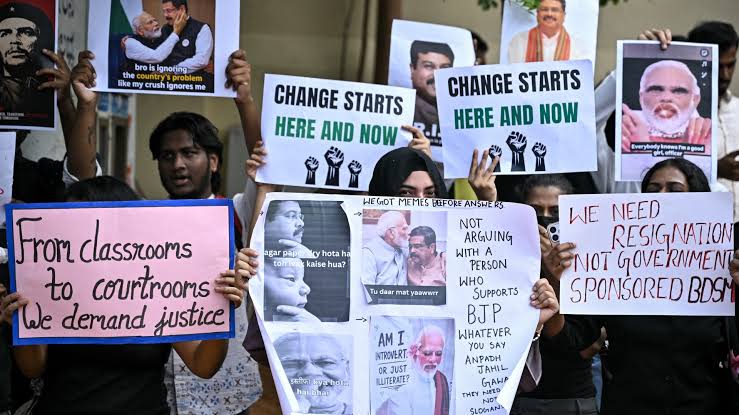
In a significant gain for youthful demonstrators, whose escalating protests have posed an uncommon and increasing challenge to Prime Minister Narendra Modi's administration, India's education minister announced his resignation on Saturday.
Following claims that entrance examinations to prestigious medical schools were leaked and sold, protesters have been demanding accountability. The Cockroach Janta Party (CJP), a youth movement, is spearheading the agitation.
In response to growing pressure with tens of thousands of students and supporters taking to the streets to demand his dismissal and extensive changes to India's examination system, Dharmendra Pradhan announced his resignation on Saturday. Modi has not yet acknowledged his resignation in public.
In a statement after the news, CJP founder Abhijeet Dipke praised Pradhan's resignation but noted that more work needed to be done. "This is democracy." He's quit. We have two more requests. "We won't proceed in this manner," he declared.
Dipke stated, "The families of the children who committed suicide should receive compensation of one crore rupees," alluding to claims in Indian media that a number of students who passed medical examinations committed themselves after discovering their results will be cancelled. Additionally, he demanded that police officers responsible for suppressing protesters earlier this week face consequences.
Nitin Nabin, the national president of the ruling Bharatiya Janata Party (BJP) and a close associate of Modi, stated that Pradhan's resignation "reflects the highest standards of integrity and selfless service in public life." The party "stands firmly" with him in his choice, he continued.
This week's clashes between protesters and police officers have increased youth resentment and garnered broader sympathy for the protest movement.
The government has suffered a rare setback with Pradhan's departure. As a third-term leader, Modi is usually unaffected by demonstrations. His government has long been accused by critics of suppressing opposition and dissent in the biggest democracy in the world.
Demonstrators have been camped in the center of New Delhi for weeks, demanding accountability over claims that millions of students were forced to retake entrance exams for India's highly competitive and prestigious medical institutions because the exams were leaked and sold.
The CJP, a youth-led initiative that started out as an internet joke but has grown into a political force that represents the annoyances of millions of young Indians, has been leading the effort.
A generation's rallying cry
The CJP was founded in May by Abhijeet Dipke, a graduate of Boston University, following remarks made by India's top justice that were widely perceived as equating young people without jobs to "cockroaches." The comments immediately became a rallying cry for a generation that claims it feels disregarded by people in positions of authority, striking a nerve in a nation dealing with consistently high youth unemployment.
What started out as a meme quickly grew into a national protest movement that brought young job seekers and students together around calls for systemic change, accountability, and opportunity.
Demonstrators are demanding a reform of an examination system that has been the subject of debate for a long time. They claim that this system puts a great deal of pressure on students and lays a significant financial strain on families who make significant investments in their children's futures.
Additionally, they have been drawing attention to India's chronic youth unemployment.
According to a recent study by Azim Premji University in Bengaluru, India has one of the youngest populations in the world, with over 360 million people between the ages of 15 and 29.
However, according to the research, the shift from education to unemployment is a "major challenge," with roughly 40% of graduates under the age of 25 and 20% of those between the ages of 20 and 29 unemployed.
Following a police raid earlier in the week that used batons and tear gas to disperse groups of demonstrators moving toward Parliament, tensions increased.
Many of the demonstrators are from middle-class families who had previously supported Modi's ruling BJP party but are becoming more and more irate at what they see as a lack of possibilities in contemporary India.
Despite winning a third term in 2024, Modi's government had to rely on allies in parliament for the first time, and his party's majority was diminished. India has a big youth population, and young voters will be important in next elections.
Modi responded to protesters in public for the first time on Thursday after weeks of failing to acknowledge or discuss them.
"Over the past two and a half months since the paper leak incident, numerous effective measures have been taken," he stated. "Those in charge have been taken into custody and are currently incarcerated. Ensuring that the pupils' academic year is not wasted has been our primary duty.
He also gave X a hazy warning earlier this week. "Those who attempt to undermine our children's future will not be spared."


