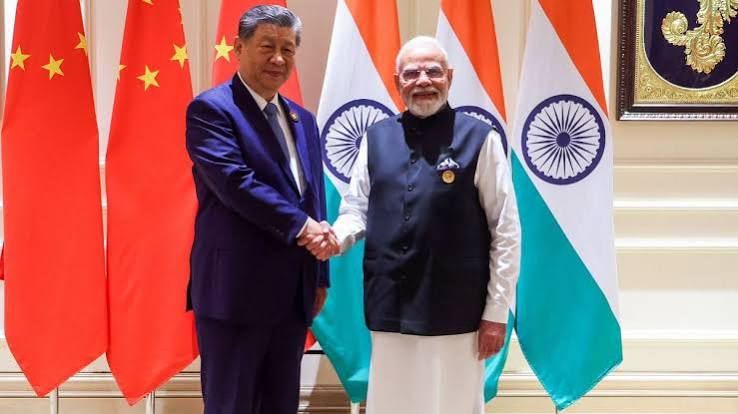
China has praised Prime Minister Narendra Modi's claim that India has an independent foreign policy and that no third party influences its interactions with Beijing, characterizing the statement as important for the future of China-India relations.
The remarks followed bilateral discussions between Prime Minister Narendra Modi and Chinese President Xi Jinping during the 18th BRICS Summit in New Delhi. After seven years, it was Xi's first bilateral trip to India. Beijing praised the encounter, which was the third time the two leaders had met in three years, as another significant step in efforts to strengthen bilateral relations.
According to Guo Jiakun, a spokesman for the Chinese Foreign Ministry, the most recent meeting was a confirmation of the path China-India relations have been taking, starting with the resumption of engagement in Kazan and continuing with advancements in Tianjin and now New Delhi.At a news conference, Guo stated, "The most significant agreement reached is that China and India should be partners."
PM Modi's independent foreign policy message is welcomed by China.
Beijing specifically highlighted the PM's comments regarding India's attitude to China and its strategic autonomy.
Guo claims that PM Modi stated that "India has an independent foreign policy," that "no third party" has "affected the development of India-China relations," and that India will not allow any force to carry out anti-Chinese operations from its territory.
"China values Prime Minister Modi's statements," Guo stated.
In the midst of border tensions, the statements highlight an attempt by both parties to establish a more autonomous bilateral relationship.
According to Guo, Xi emphasized that although China and India have distinct national conditions, they should work to assist each other's growth and capitalize on each other's advantages."Both sides must calibrate the direction with an objective and rational strategic perception in order to promote the steady and sustained development of China-India relations," he stated. In addition, the Chinese official urged the two nations to increase cooperation while resolving disagreements via "mutual respect and mutual understanding".
The two presidents concurred that the bilateral relationship's primary goal should continue to be development. The two most populous nations in the world and significant contributors to the Global South are China and India. Beijing stated that in order to enhance public impressions of their relationship, both nations should focus on economic development, increase amicable interactions and mutually beneficial cooperation.
Trade and economic concerns also had a significant role in the mutual understanding.
According to Guo, China and India should strive for the "sound and steady development" of their bilateral economic ties while balancing each other's trade and economic concerns. Additionally, the two nations decided to deepen their collaboration through multilateral forums, including BRICS and the broader Global South.
BORDER DISPUTES MUST BE HANDLED CAREFULLY
China and India continue to have disagreements despite efforts to strengthen their relationship, especially regarding their long-standing border dispute. According to the Chinese Foreign Ministry, the two leaders decided that differences and conflicts should be handled appropriately to maintain peace and tranquility along the border.
Beijing claimed that better ties between China and India would benefit both nations' citizens as well as broader development collaboration. China now plans to deepen coordination in international forums, increase people-to-people interactions, and broaden areas of cooperation in order to build on the agreements made between PM Modi and Xi.
The future of BRICS was another major topic of discussion during Xi's visit to New Delhi, as China is getting ready to take over as the group's chair next year.
The BRICS have been working together for twenty years this year. Three themes—"self-reliance and self-strengthening, standing together through wind and rain, and fruitful outcomes"—were used by Xi to explain the group's development.
Next year, China will lead the BRICS.
Next year, China will host the 19th BRICS Summit and assume the BRICS chairmanship.
Beijing has made it clear that it intends to utilize its chairmanship to foster agreement among member nations and outline the next stage of collaboration. Xi suggested three initiatives during the New Delhi summit: a digital industry cooperation initiative, an intelligent manufacturing cooperation initiative, and an open-source and inclusive artificial intelligence project.
A BRICS digital ecosystem cloud platform, a BRICS AI open-source community, and a youth exchange program centered on scientific and technical innovation are just a few of the practical steps China has proposed.
According to Guo, China wants other nations in the Global South to increase their ability to take advantage of new technology and contribute to their advancement.


