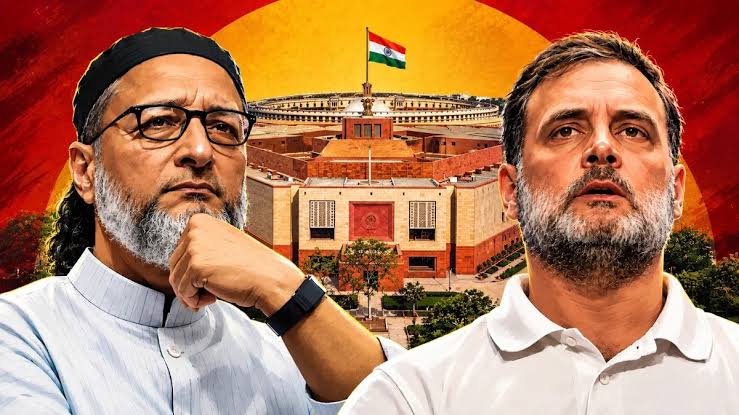
After an inquiry report showed that Gyanesh Kumar, the Chief Election Commissioner (CEC), had rejected the opposition of two other Election Commissioners on important matters, including the Special Intensive Revision (SIR) exercise, the Opposition attacked both the administration and Kumar. Gyanesh Kumar's departure from the Election Commission of India (ECI) and his selection procedure are being questioned by opposition politicians. However, when the administration passed the legislation governing the ECI member selection procedure, the majority of Opposition MPs were not present in Parliament.
The SIR exercise was also criticized by the opposition, which is attacking Kumar. Opposition parties, especially Congress MP Rahul Gandhi, who is currently the Leader of Opposition (LoP) in the Lok Sabha, have frequently targeted 62-year-old Kumar since he was appointed CEC in 2025.
However, the BJP-led NDA government introduced a law limiting their selection in December 2023, which is when the dispute surrounding the appointment of the CEC and the two Election Commissioners began. This is when things start to get interesting. Asaduddin Owaisi, the head of AIMIM, was the only opposition MP to voice opposition to the Chief Election Commissioner and Other Election Commissioners (Appointment, Conditions of Service and Term of Office) Bill during its debate in the Lok Sabha on December 21, 2023.
However, Rahul Gandhi and the rest of the opposition were nowhere to be found.
The reasons behind the opposition attack on CEC Gyanesh Kumar
The Indian Express reported on Wednesday that Election Commissioners Sukhbir Singh Sandhu and Vivek Joshi had formally registered objections at least 14 times over a ten-month period. This led to a fresh attack on the ECI and the CEC. The two ECs said in the report that significant decisions were being made without their knowledge in the name of the entire Election Commission, with some of the activities being deemed "unauthorised and illegal".
In response, Rahul Gandhi declared on Wednesday that "vote chori" was a direct assault on the Constitution and a crime against the Indian people. The Supreme Court should take suo motu cognizance of the report, according to opposition parties.
However, The Indian Express's assertions were denied by the ECI. "Divergent opinions and observations are a normal part of deliberation in any institution," the Commission stated in a statement released following the inquiry report. Before a final choice is made, they participate in the decision-making process.
Since the government of Prime Minister Narendra Modi introduced the legislation governing the selection of the CEC and Election Commissioners in December 2023, the Congress and other opposition parties have made the ECI a key target.
HOW THE 2023 LAW SELECTS ELECTION COMMISSION MEMBERS
On December 12, 2023, the Rajya Sabha passed the Chief Election Commissioner and Other Election Commissioners (Appointment, Conditions of Service and Term of Office) Bill; on December 21, the Lok Sabha followed suit. On December 28, the president signed it into law, and on December 29, it was declared an Act.
The Opposition in the Rajya Sabha questioned the purpose of the CEC Bill. The debate was started by Congress MP Randeep Singh Surjewala, while MPs from a number of opposition parties claimed that the proposed legislation violated the Constitution. Following a walkout by the opposition, the bill was ultimately approved by voice vote.
The Prime Minister, the Leader of the Opposition in the Lok Sabha, and a Union Cabinet minister selected by the Prime Minister made up the three-person selection committee established by the statute. This took the place of the temporary selection process that the Supreme Court had established earlier that year, in which the Prime Minister, the Lok Sabha LoP, and the Chief Justice of India made up the panel.
The Supreme Court's 2023 ruling in Anoop Baranwal v. Union of India, which established the temporary procedure for selecting Election Commission members until Parliament passed legislation, caused the legislation to become contentious.
On the recommendation of the Union government, Baranwal, an advocate, has contested the current procedure of the President appointing the CEC and Election Commissioners. According to his petition, the ECI's independence may be impacted if the government were given a major say in choosing the nation's election watchdog.
A five-judge Supreme Court Constitution Bench ruled unanimously in March 2023 that appointments to the Election Commission would be made on the recommendation of a committee made up of the Prime Minister, the Lok Sabha LoP, and the Chief Justice of India (CJI) until Parliament passed legislation.
A Cabinet minister chosen by the Prime Minister took the position of the CJI under the Center's December 2023 legislation.
The Opposition's criticism of the Election Commission is still centered on that modification, which sparked a significant political scandal.
A two-judge Supreme Court bench rendered a split decision on Wednesday over whether petitions contesting the legislation governing the appointment of the CEC and ECs should be transferred to a larger, five-judge Constitution Bench, amid the Opposition's fresh outcry against the CEC. The CJI will now hear the case.
However, another issue is frequently overlooked in the discussion. Why was the Opposition hardly present in the Lok Sabha when the Bill was enacted if they were so against the new appointment process? This is the complete narrative.
One hundred opposition MPs were suspended when the CEC-Selection Bill was passed.
The exceptional circumstances of the Winter Session of Parliament in December 2023 hold part of the explanation.
The December 13 security breach, in which two intruders entered the Lok Sabha chamber with smoke bombs and caused a full-fledged security crisis, had already thrown the session into disarray. Opposition lawmakers called for a conversation about the breach and a statement from Amit Shah, the Union Home Minister at the time. Suspensions increased as protests persisted.
141 MPs from both Houses were suspended as of December 19. The Lok Sabha's Opposition benches were nearly vacant.
In the end, the number was even higher. Three more members of Congress were suspended on December 21, 2023, the day the CEC Bill was passed. As a result, there are now 100 suspended Lok Sabha MPs. During the session, 146 MPs from both Houses were suspended. The Opposition held 142 MPs in the Lok Sabha as of 2023.
The most important thing was the timing. On the same day that the House added the last three suspensions, the CEC Bill was discussed in the Lok Sabha. The bill was approved by voice vote following a brief debate that lasted, according to reports, one hour and forty minutes.
Twelve MPs took part in the debate, primarily from the BJP and the NDA, according to media sources. The only speaker who opposed the Bill during the Lok Sabha debate was Asaduddin Owaisi, the MP for Hyderabad.
The seeming contradiction in today's criticism of the Opposition stems from this important context.
When the bill was passed, what was Rahul Gandhi doing?
This review is significant since Rahul Gandhi has been the most vocal opponent of the ECI and CEC Gyanesh Kumar among all the opposition parties and their leaders.
When the law was enacted, Rahul Gandhi was not one of the MPs suspended from the Lok Sabha. However, he was not given the opportunity to speak during the December 21 Lok Sabha debate on the CEC Bill.
Rather, the Opposition's outcry over the Parliament security breach and the widespread suspensions dominated his public appearances that week.
At that time, the suspensions and the call for a response from the home minister regarding the security breach on December 13 dominated the attention of the broader Opposition. Rahul Gandhi was unable to voice his disapproval. His inability to document his dissent is explained by the sequence of events that occurred at the time.
Rather than just asking why the Opposition did not oppose the Bill, the sequence of events provides a more nuanced answer. Amidst the controversy surrounding the security breach, widespread suspensions, and a severely disrupted Winter Session, the law was passed. Owaisi was the sole Opposition MP to get a chance to speak against the Bill, while Rahul Gandhi was in the Lok Sabha but was unable to take part in the debate.
Since then, the issue regarding the ECI's independence has progressed significantly from that discussion in December 2023. However, the legislative record of December 21—who was suspended, who spoke, and who did not—remains a crucial component of the narrative when the Opposition revisits the beginnings of the current appointment system.


