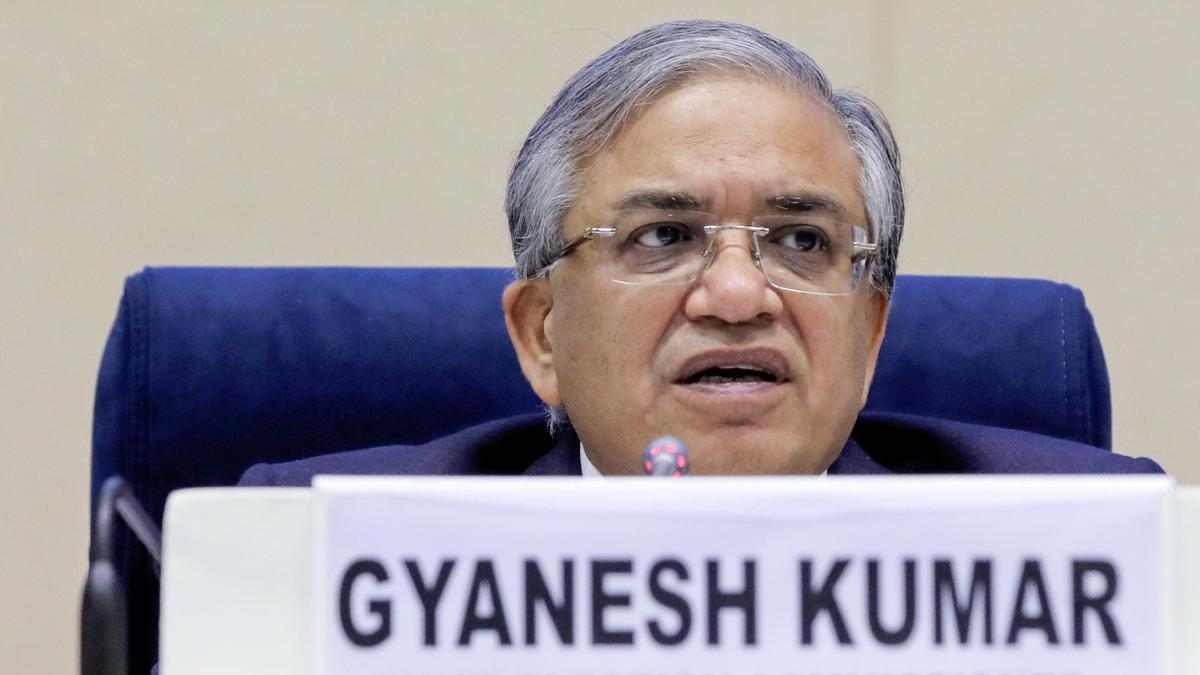
Gyanesh Kumar, the Chief Election Commissioner (CEC), is legitimately under investigation. Two Election Commissioners' (ECs) concerns about dissent are the reason for the outcry against the CEC. However, why did the two ECs continue to engage in joint decisions and news conferences, contact the Cabinet Secretary rather than the President, and ultimately remain in their positions if their disagreement was consistently disregarded?
A pattern of objections filed by two ECs, Sukhbir Singh Sandhu and Vivek Joshi, on matters pertaining to electoral rolls, Form 6, access to voter data, and the operation of the poll body's IT systems was discovered by the Indian Express newspaper's investigation into the Election Commission of India (ECI) on Wednesday, September 23. In general, it raised concerns regarding the manner in which CEC Gyanesh Kumar implemented the Special Intensive Revision (SIR).
The report states that the two commissioners voiced reservations at least "14 times over 10 months — once four times in a single day" and expressed concerns that centralized control of the electoral-roll database was limiting the statutory rights of electoral registration officers (EROs).
These are not small-scale administrative disputes. They have to do with the systems used for voter registration and the creation and upkeep of electoral rolls. These questions require responses if the CEC disregarded a legitimate majority, allowed legislative authorities to be weakened, or permitted decisions to be made without consulting the Commission.
The two election commissioners and the chief election commissioner are equal for the purposes of the record. He is not more powerful than the ECs because he is the chief of the CEC.
The investigation of CEC Gyanesh Kumar is warranted in light of the report that revealed the two ECs' dissents. However, it's also critical to consider whether the two ECs made every effort to draw attention to their reservations.
There are certain aspects of The Indian Express's story that highlight issues that the ECs must address.
Why did they continue to take part in the public defense of the Commission if they felt that its operations had become so problematic that their objections were consistently disregarded? When they disagreed, why didn't they demand a formal meeting of the entire Commission? Given that the Election Commission is a separate constitutional agency, why did they write to the Cabinet Secretary? Did they send a letter to the president, who grants their appointment?
In the end, why didn't the ECs submit their resignation if they felt their concerns had escalated to the point where the institution was no longer operating as it ought to? The scrutiny of Gyanesh Kumar is not lessened by these inquiries. In fact, they finish it.
The questions should be answered by CEC Gyanesh Kumar.
There must be a definite beginning point. The fact that the two ECs are also under review does not absolve CEC Gyanesh Kumar.
According to the Indian Express, Sandhu and Joshi documented complaints about the Commission's operations on multiple occasions. The progressive centralization of the electoral-roll database and the operation of the ECI's IT architecture were two of the biggest points of contention.
Form 6, the statutory form used by new voters to register, also caused controversy.
Joshi said on May 16, 2026, that as Form 6 was required by the Registration of Electors Rules, 1960, the suggested modifications could not be done through a SIR order. He recommended sending the issue to the government so that the relevant regulations might be changed. On May 19, Sandhu agreed with him.
However, The Indian Express claims that the contentious modifications later surfaced on ECINet, the ECI's web platform. Sandhu once more noted on August 13 that the modifications were "unauthorised or illegal" and demanded their removal.
The obvious question is what would have happened if two of the three commissioners had adopted this stance.
Was their opinion disregarded? Did the Commission make a formal decision? Was a majority present? Did all three of them discuss the issue? What was the legal basis for the CEC's disagreement?
Gyanesh Kumar and the ECI ought to respond to these queries.
Because Article 324 creates the Election Commission as a separate constitutional body, the matter is especially crucial. The multi-member Commission will make decisions under the 2023 statute governing the CEC and ECs, with a majority ruling in cases where unanimity is not feasible.
Therefore, it goes beyond only whether Sandhu and Joshi didn't agree with Gyanesh Kumar. Actually, the question is whether their dispute was resolved in a way that complied with the law. Furthermore, it's unclear if the two made full use of the legal authority at their disposal.
EVEN AFTER DISSENT, WHY HOLD JOINT PRESS BRIEFINGS AND MEETINGS?
The other part of the story, which is not commonly told, starts at this point. The two ECs' actions should be investigated if they felt that their concerns were routinely disregarded.
Attend the press briefings. On August 7, 2025, Rahul Gandhi, the leader of the opposition in the Lok Sabha, made his first accusation of "vote chori" at a news conference. Gyanesh Kumar spoke to the media ten days later, on August 17, to answer those accusations and support the Election Commission's stance.
He was accompanied by Sandhu and Joshi.
Given their later admissions regarding their worries over the electoral roll procedure, this is noteworthy. Their participation does not indicate that they concurred with all of the CEC's statements. Additionally, attending a press conference does not guaranty that all internal conflicts are resolved. However, it does bring up a legitimate institutional query.
What stance were they all taking to the public if they previously thought that the Commission's operations were seriously flawed?
In 2026, the subject became even more pertinent. The three commissioners continued to appear together in public following the launch of ECINet on January 22 and as worries about the centralization of electoral-roll data were being documented.
In March, they made joint appearances, such as the release of the election calendar on March 15 and a press conference on March 10.
While maintaining an institutional stance on the outside, a multi-member constitutional body may have internal disagreements. However, the public has a right to know how that consensus was reached if the conflicts were fundamental. The minutes, notes, and records of the Commission's meetings are important because of this. Why did the two take a united stance on behalf of the ECI if their differences were fundamental?
Why is there no public clarity if the two ECs have a majority?
During a conversation on India Today TV, political analyst Rajat Sethi posed what may be the most significant institutional question.
The key question, according to him, was whether the two ECs had expressed concerns on different issues while the final decision still had majority support, or if they had collectively opposed specific judgments, creating a majority against the CEC.Speaking to India Today TV's Consulting Editor Rajdeep Sardesai, Sethi stated, "If the two commissioners are on one side of a decision, they could have called the full-fledged meeting of the Election Commission on their own."
Seth's differentiation is crucial. The presence of dissenting notes does not always imply that the Commission's decision was unlawful.
The ECI is a multi-member body under the statutory framework, and in the absence of unanimity, decisions may be made by the majority.
Thus, the question at hand is whether Sandhu and Joshi collectively represent a majority opposing the final decision.
If so, how was that majority handled? If not, what was decided in the end, and who was in favor of it? However, these specifics are not in the public domain.
In their article, the Indian Express also stated that on September 21, they addressed a questionnaire to the ECI on the issues raised by the two election commissioners, inquiring as to what steps were taken to resolve their concerns. No answer was given.
For clarity, it also said that emails were sent to both ECs on the same day. Two phone calls were made in response to both emails. The ECs did not respond.
WHY DO THE ECs NEED TO TALK TO THE CABINET SECRETARY?
The Election Commissioners' July 29 letters are the subject of the second main query.
The Indian Express reports that Sandhu and Joshi each wrote to Cabinet Secretary TV Somanathan the day after Senior Deputy Election Commissioner Maneesh Garg altered the task distribution within the Commission's administration division on July 28.
They requested appropriate action and stated in the letter that the move was a violation. The ECs voiced serious concerns. They had already voiced worries about the IT division's oversight structure, which was impacted by the contested task allocation.
However, there is a constitutional issue with the choice to speak with the Cabinet Secretary. This was questioned by political expert Yogendra Yadav during the India Today TV discussion.Does the Indian Election Commission report to the Cabinet Secretary?Yadav inquired.
The claim is not that it is impossible to approach the Cabinet Secretary in any situation. However, why should members of an independent body file a complaint against a fellow commissioner with a government executive?
The President appoints the Election Commissioners and the CEC. The Election Commission is not administratively subordinate to the Cabinet Secretary and derives its constitutional authority from Article 324.
According to Yadav, the constitutional course of action would have been to contact the President if the two commissioners felt that the internal institutional procedure had failed. This raises valid concerns about their selection of the Cabinet Secretary.
Finally, the most potent kind of dissent appears.
The most difficult question is about to be asked. Why did the two ECs not step down?
An Election Commissioner's disagreement with the CEC does not necessitate resignation. In institutional decision-making, dissent is a recognized component.
However, when an office holder feels that the organization has essentially ceased operating in compliance with the law, resignation becomes a separate matter.
What was the extent of Sandhu and Joshi's institutional tolerance if they felt that their objections were consistently disregarded, that statutory powers were being restricted, that electoral-roll systems were being centralized without sufficient oversight, and that their authority was being circumvented?
In essence, Yogendra Yadav argues that accountability cannot end with the recording of criticism.
Rajat Sethi also questioned the two commissioners' actions.
The ECs worked together to issue the work-allocation order on July 28. Together, they overturned the directive after sending separate letters to the Cabinet Secretary.
This indicates that they were able to exercise institutional authority as a group. Why, therefore, wasn't that strategy applied earlier in the conflicts that The Indian Express documented?
And why stay in office if they thought that even these kinds of procedures had failed? This does not absolve CEC Gyansh Kumar of scrutiny.
Gyanesh Kumar has to be investigated in light of the disclosures regarding Form 6, electoral-roll access, the IT system, and the purported centralization of the database. The public should be given a clear explanation if the CEC ignored a legitimate majority, enabled statutory procedures to be circumvented, or permitted decisions to be made without the Commission's consent. However, why should the CEC be the only one examined? The other two ought to be questioned as well.


