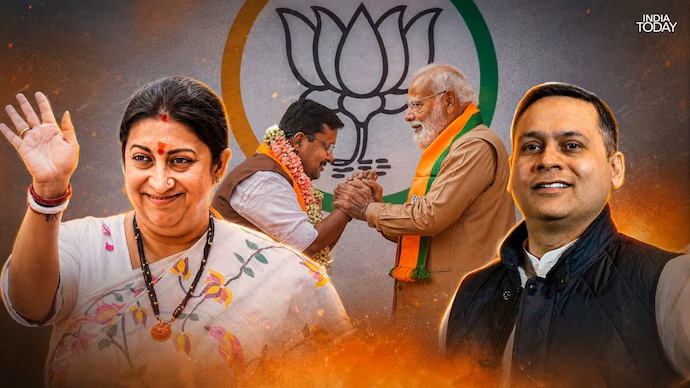
The first significant organizational reorganization of the Bharatiya Janata Party (BJP) under President Nitin Nabin took place on Monday, August 17, and it goes beyond simply switching office holders. The change signifies a major generational and strategic reset, with 51 of the 65 office-bearers being new hires. The expulsion of Amit Malviya from the party's social media unit and the return of Smriti Irani and Ram Madhav indicate that the BJP isn't just searching for fresh faces. It is attempting to convey a message while resetting itself in the face of a younger electorate.
The BJP's new team arrives at a crucial political juncture. Five states have assembly elections coming up, with Uttar Pradesh—where the BJP lost the 2024 Lok Sabha elections—becoming a major focus. Many believe that the reorganization is a prelude to the upcoming election cycle, which includes the 2029 Lok Sabha election, in which Gen Z voters would play a significant role.
The figures demonstrate the variety of reforms implemented by the saffron party. Nine of the thirteen national vice-presidents are new. Fifteen of the sixteen national secretaries are new appointments, while six of the eight general secretaries are first-timers. However, the party has brought back leaders like Irani and Madhav while keeping a number of seasoned faces, such as Vasundhara Raje Scindia, Vinod Tawde, and Sunil Bansal. Meanwhile, Piyush Goyal returns as national treasurer while serving as the Union Commerce and Industry Minister.
The calculated generational shift of the BJP in the new team
Rather than a complete replacement of the old guard, the makeup of the BJP's recently announced national team, led by 45-year-old party president Nitin Nabin, suggests a carefully managed generational change.
The team's average age is approximately 53, while 21 of the 65 announced office bearers are under 50, including six under 40 and 15 in the 40–49 age range. The BJP has purposefully kept organizational stalwarts with newer leaders, as evidenced by the 23 members who are 60 years of age or older.
Therefore, the message is about developing a second line of leadership without upsetting institutional continuity rather than just making the party younger.
While the presence of seasoned strategists guaranties that the party maintains its organizational and electoral strength ahead of the pivotal 2027 Assembly elections and the 2029 Lok Sabha battle, the introduction of younger faces into important organizational positions allows Nabin to develop a leadership pipeline.
THE GIANT KILLER'S RETURN TO THE WAR ROOM: SMRITI IRANI
Smriti Irani's selection as national general secretary is the BJP's most politically charged appointment.
The appointment represents a major return to the BJP's top organizational structure for a leader who moved from being one of the most recognizable faces of the Narendra Modi government since 2014 to losing her Amethi Lok Sabha seat in 2024.
Irani's return to the BJP's core group is undoubtedly more than just a political rehabilitation exercise. Her political identity is still strongly associated with Uttar Pradesh.
Irani defeated Rahul Gandhi, the leader of the Congress at the time, in Amethi in 2019 by a margin of 55,120 votes. For many years, the Amethi Lok Sabha constituency was regarded as the Gandhi family's stronghold. She became one of the BJP's most well-known campaigners and was dubbed the "giant killer" after defeating Rahul Gandhi in a seat he had held since 2004.
Irani lost Amethi to Congressman Kishori Lal Sharma in 2024, five years later. Her 2019 triumph remained politically significant despite the reversal, especially within the BJP cadre.
The party now has a rationale to use a leader who has already shown that she can become a political symbol in one of India's most significant electoral battlegrounds as Uttar Pradesh prepares for Assembly elections in 2027.
Irani's return to the BJP's core team is also perceived as an attempt by the saffron camp to use her as a political counterbalance to Rahul Gandhi's growing prominence. "Smriti Irani's appointment as one of the general secretaries conveys a special message to the Congress." Rahul Gandhi was defeated by her. A strong, multilingual speaker, she will spearhead the fight against the Gandhis in Uttar Pradesh and across the country," prominent journalist Prabhu Chawla wrote on X on Monday.
The centrality of the state to the reorganization is highlighted by the fact that eight Uttar Pradesh leaders have been appointed to important positions in the new national organization.
Irani has much to offer. She is a well-known female leader with backgrounds in both the Union government and electoral politics. She has a lengthy history of involvement with youth-focused political issues and has held the position of Education Minister. Because she is a well-known TV actress, younger voters are more aware with the BJP because to her public persona and social media presence.
BJP'S DIGITAL RESET, AMIT MALVIYA'S NAME DROPPED
Amit Malviya's departure from the party's digital leadership signifies a willingness to alter a system that had grown to be associated with a single person, while Irani's return signifies the BJP bringing back a proven political face.
Since taking over the BJP's IT Cell in 2015, Malviya has been instrumental in the party's digital campaigns, social media operations, and website. He developed become one of the BJP's most well-known web strategists over time and a crucial player in its narrative-setting initiatives.
One of the most significant changes to the BJP's new team is the replacement of Malviya by Deepak Mhaske, a Chhattisgarh-based professor and political organizer with expertise in electoral data who will now spearhead the party's social media outreach.
With Priti Gandhi, Shivanand Dwivedi, Alok Bhatt, and Arun Yadav among the new co-convenors, the entire social media structure has essentially been redesigned.
Malviya's dismissal has not been made public by the BJP. Because of this, it is easy to see the action as a judgment on the party's online performance. However, drawing such a judgment would be premature.
In a recent analysis, Nistula Hebbar, the political editor of The Hindu, stated that "Malviya's exit is also due to a new party president wanting to bring in his own people." Hebbar explained that when Mhaske was one of the party leaders overseeing the Chhattisgarh Assembly elections in 2023, Nabin, the party chief, collaborated closely with him.
Malviya's record was by no means unimportant. He played a significant role in West Bengal, where the BJP made its strongest-ever election effort and became the government in 2026. In BJP circles, he was credited with helping the party dominate the digital battlefield. Additionally, the BJP's electoral campaigns were characterized by his digital apparatus.
However, the political landscape surrounding social media has evolved.
What many perceived as a communication gap between the BJP and segments of younger voters was shown by the recent protests, including the Cockroach Janta Party (CJP) campaign and the outrage surrounding the NEET paper leak. Not only was the opposition criticized, but several members of the BJP's own supporters questioned the party's communication tactics.
This does not imply that Malviya was the only one at fault. However, it may have raised more general organizational concerns. A methodical reset seems to be the answer to every question.
The party is not giving up on digital politics, as seen by the appointment of individuals who are already acquainted with the pro-BJP internet community. Instead, it is trying to make its digital operations more decentralized, data-driven, and sensitive to younger audiences and fresh platforms.
THE BJP'S NEXT GENERATION TEAM FOR NEW FIGHTS
The BJP's new administration seems to be striking a balance between organizational rejuvenation and electoral experience.
Ram Madhav, a seasoned strategist with extensive ties to both the RSS and the BJP, has returned to a pivotal position. Tariq Mansoor and Baijayant Panda continue to hold significant roles, and Vasundhara Raje is still the country's vise president. Lal Singh Arya's position as president of the SC Morcha has been elevated. Harish Dwivedi is now the general secretary.
The BJP appears to be teaching its members that while experience is still important, longevity cannot be ensured by past performance alone. The party is prepared to replace those who have held important organizational positions for years with leaders who still have electoral worth.
This is especially evident in the differences between Malviya and Irani.
One is being reinstated because the party still believes that a seasoned campaigner has political worth. After over ten years at the heart of the BJP's digital strategy, the other has been replaced. As a result, it is evident from Nitin Nabin's first major team that while the BJP is preparing for the election, it does not plan to fight the upcoming battles in the same manner as it has in the past.


