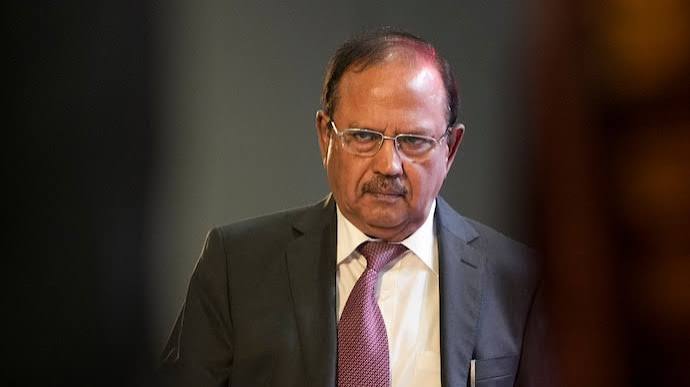
When an operation along the China border went wrong, Ajit Doval, a National Security Adviser (NSA) in his 20s, was just starting out in the intelligence field. Doval thought his career would end as a result of the incident. Rather, it taught him a lesson in life that he claims has stuck with him ever since. Speaking at the IIT Roorkee commencement on Saturday, the typically reserved NSA recalled the audacious mission.
Doval claimed to have been assigned as Sikkim's intelligence chief at the time. His duties included monitoring the border regions and obtaining intelligence on the movements and operations of the People's Liberation Army (PLA) of China.
AJIT DOVAL RECALLS THE SIKKIM MISSION.
I was assigned to Sikkim as the intelligence chief while I was in my 20s. At the time, that was not a part of India. It was joining India. "I participated in the merger process," Doval stated.
The Chogyals of the Namgyal dynasty ruled Sikkim as an autonomous state for more than three centuries. Sikkim became an Indian protectorate in 1950 after signing a contract following India's independence. In essence, it granted India self-rule and authority over its foreign and defense policies.
In 1975, Sikkim was formally incorporated into India, a move that is still shrouded in mystery.
A top-secret RAW campaign that lasted more than two years was the driving force behind the merger. More information on it can be found here.
Doval was transferred to the Himalayan state during this time of merging. During one such trip, Doval recalled, he dispatched a team to gather intelligence close to the border. They were supposed to be back in eight days. But 15 days passed with no communication from the crew.
"It was a really serious issue for me, both personally and professionally.
We had no idea what had happened to them or if they were dead," Doval remarked. There were no reports of any avalanches or other natural disasters.
He soon got a call from headquarters, Doval remembered. "Have you sent some people across?" inquired my supervisor. "I don't know," I answered. "They must be on their way," Doval remarked. When he learned that the Chinese army had captured his team, his greatest fears were realized. They were also questioned.
But the Indian agents were freed a few days later.
According to Doval, "some deal must have been struck" most likely.They came back completely destroyed and in disarray, the NSA recalled.I believed my career was coming to an end.
The incident was distressing and difficult for Doval, who was just in his 20s. After an investigation was started, Doval thought his career was over.I was aware that my career was coming to an end. I believed that I needed to begin a new profession. He remembered, "I thought the event was really unprofessional.
But in the end, Doval received a clean chit.
Why? because the inquiry team discovered mistakes in the maps and sketches that HQ had given his crew. "I wasn't found to be at blame. I had probably done everything correctly," Doval remarked.
He was genuinely saddened and shaken by the incident, even though he was not held accountable. "I felt really depressed. "It was one of those times in life when you feel really depressed," Doval recounted.
But he was able to deal with the incident thanks to an unexpected piece of advise from a Tibetan Sherpa who worked with him at the Intelligence Bureau.
It's all about reading maps.
The Sherpa was cited by Doval as saying, "Some people read maps correctly, while others do not." Doval said the Sherpa spent years traveling across snow-covered mountains, but he did not disclose his identity.
Then, according to Doval, the Sherpa gave him three guiding principles. "First, be aware of your location. Secondly, be aware of your destination. Thirdly, be aware of how to get there," Doval recalled.
Doval used the suggestion as a perspective on life in general.
Since then, Doval has developed into one of India's most well-known and skilled spies.
He has led important national security operations as NSA since 2014, such as the 2016 surgical strikes in Pakistan, the 2019 Balakot airstrike, and Operation Sindoor in 2025.


